Comparing LCA Training for manufacturing companies: Environmental Impacts Academy, Sphera, SimaPro and GreenDelta
Which LCA Training Is Right for Manufacturing Companies?
If your company needs product-level environmental data, wants to design more environmentally friendly products, or needs environmental performance to shape how you compete, someone has to do the work.
And that work goes far beyond modelling a product in LCA software.
Someone, or an entire team, needs to gather data from across the organisation. Decide what is being assessed and why. Build the models. Agree on consistent modelling choices and company practices. Make decisions when the available data isn't perfect. Interpret the results and communicate what they mean.
Over time, the work may go further still: improving data quality, redesigning data systems to better support LCA, and creating repeatable processes so the company doesn't have to start from scratch with every new assessment.
In other words, building LCA capability is not only about learning how to use an LCA tool.
It is also about learning how to do the work that happens outside of the tool.
This raises an important question when choosing LCA training: Are you looking to learn a particular software tool, or do you want to develop the skills to carry out LCA work in your organisation?
The distinction matters because different training approaches prepare you for different tasks.
What is the difference between software-focused and project-based LCA training?
Software-focused LCA training primarily teaches you how to use a specific tool and apply LCA methodology through predefined exercises. Project-based LCA training covers the broader process of conducting a real LCA, from defining the study's goal and scope to collecting data, building the model, making methodological decisions and interpreting the results.
For example, modelling a product using a prepared dataset is quite different from having to find the right production data within your organisation, decide how to handle missing supplier information, or determine how environmental impacts should be allocated between products.
These are challenges you encounter when conducting a real LCA, and they require more than knowing how to operate the software.
Both approaches have their place. The right choice depends on whether you primarily need to learn a tool or develop the skills to carry out LCA work in practice.
How does Environmental Impact Academy’s Hands-On LCA Training compare with Sphera, SimaPro and openLCA trainings?
The main difference is the scope of practical application. Environmental Impact Academy’s Hands-On LCA Training uses a project-based approach, combining LCA methodology and software training with an eight-week guided LCA project using a real company product.
The standard courses reviewed from Sphera, PRé Sustainabity/SimaPro and GreenDelta/openLCA focus on software instruction, LCA methodology and modelling exercises. They do not specify a supported LCA project using the participant's own company product as a standard deliverable.
To compare these programs, we looked at their duration, format, practical work, project support, software access and intended learning outcomes. We also considered four questions that matter when building internal LCA capability
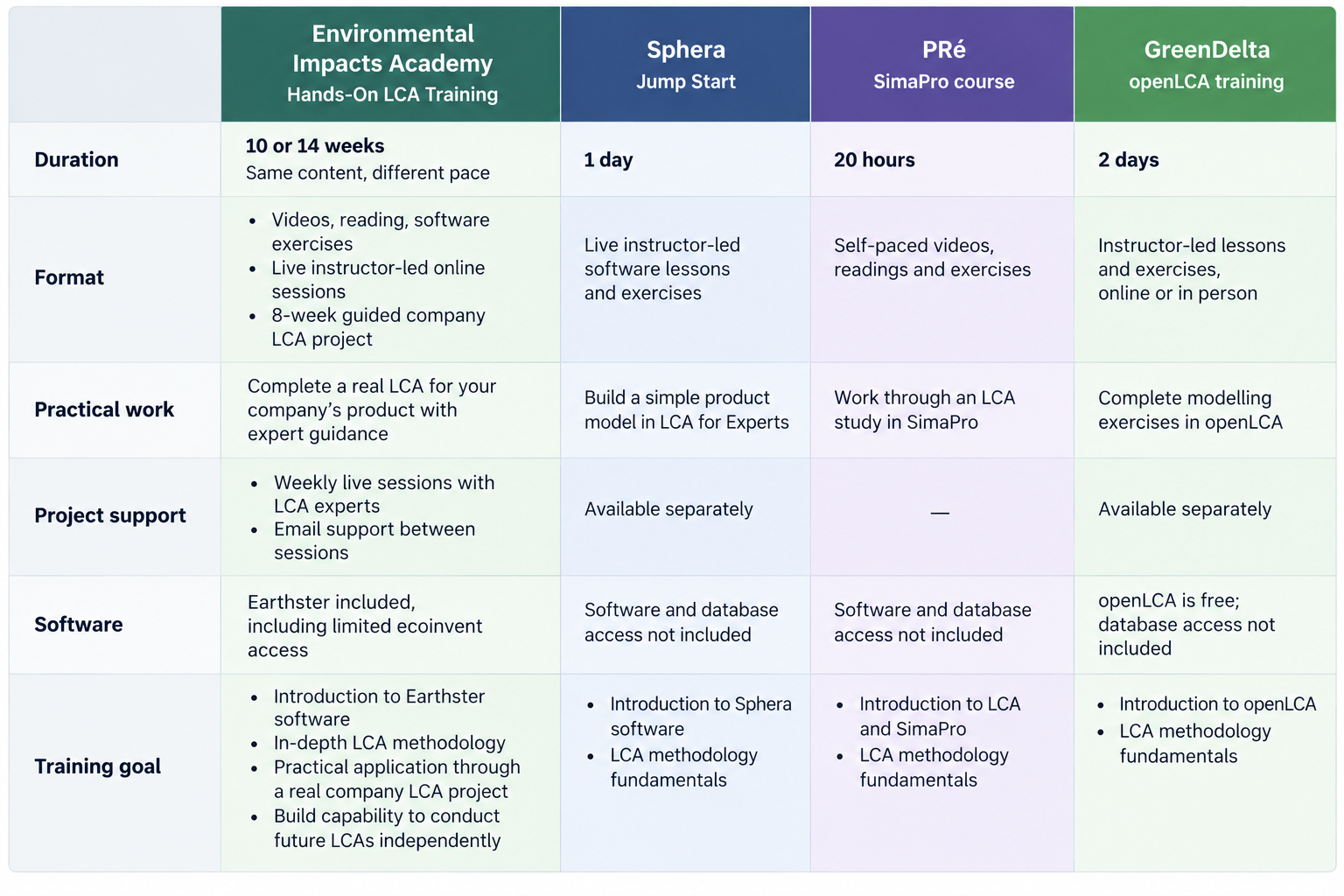
The comparison table highlights differences in training length, format, practical work and support for all 4 providers: Environmental Impacts Academy’s Hands-on LCA Training program, Spheras Jump Start, Pré Sustainabilitys SimaPro Course and GreenDeltas openLCA Training.
What do these differences mean in practice?
The comparison table highlights differences in training length, format, practical work and support. But what do these differences mean for someone choosing LCA training for themselves or their team?
Let's look at what you can expect to learn, what you will actually do during the training and what you can take away from it.
Do I need previous LCA experience?
Not necessarily. Some LCA training programs are designed for beginners, while others assume you already understand LCA methodology and primarily need to learn a new software tool.
Environmental Impacts Academy's Hands-On LCA Training is designed for professionals who want to build the skills and confidence to conduct LCAs independently. Whether you're a complete beginner or already have some LCA experience, the training adapts to your starting level. It combines a solid foundation in LCA methodology with a guided company project, allowing participants to develop their skills through real-world application and expert feedback.
PRé’s Effective LCA with SimaPro also states that no previous LCA experience is required, although access to SimaPro is required separately.
Sphera’s Jump Start is different. It expects participants to already understand LCA methodology and focuses more specifically on getting started with modelling in Sphera’s software.
For GreenDelta, the appropriate starting point depends on whether you take the Basic or Intermediate openLCA training.
How much LCA can you realistically learn in one or two days?
A one- or two-day LCA course can introduce you to LCA methodology, teach you the basics of a software tool and give you experience with modelling exercises. However, developing the skills to conduct LCAs independently generally requires more extensive practice.
The challenge isn't just understanding LCA concepts. It's learning to apply them when there isn't an obvious answer.
For example, you might understand allocation in theory, but how do you decide which allocation method is appropriate for a particular production process? Or how do you judge whether a database proxy is representative enough when the exact material or process isn't available?
These are the kinds of questions that emerge when you conduct a real LCA. They require methodological judgement, which develops through practice, feedback and experience, something that is difficult to replicate fully through lectures and predefined exercises alone.
This difference in learning objectives is reflected in the length of the training programs.
Sphera's Jump Start is a one-day course, GreenDelta's training takes two days, and PRé's self-paced SimaPro course takes approximately 20 hours.
Environmental Impact Academy's Hands-On LCA Training, on the other hand, runs for 10 or 14 weeks, depending on the pace selected. This includes an eight-week guided company project, where participants apply what they've learned to a real LCA, work through the challenges they encounter and discuss their decisions with LCA experts in weekly live sessions.
The additional time isn't simply more time spent learning theory or software. It's time spent doing LCA, making decisions, receiving feedback and developing the confidence to approach future projects more independently.
Will I complete an LCA for my own company's product during training?
Yes. Environmental Impact Academy's Hands-On LCA Training is the only program in this comparison that includes completing an LCA for a real company product as part of its standard training. Participants work on their project over eight weeks, with weekly expert sessions and support between meetings.
The standard Sphera, PRé/SimaPro and GreenDelta/openLCA courses reviewed here focus on modelling exercises and example studies rather than a guided company LCA project.
For manufacturing companies, this means the training project can focus on one of your own products. As the LCA develops, your team can begin identifying environmental hotspots and opportunities for improvement, while developing the skills to conduct future assessments.
For consultants, the project can be a real client assignment. Rather than practising solely with fictional case studies, you can develop your LCA skills while working on a project that may also generate billable hours.
The project serves two purposes: developing practical LCA capability and producing work that can have immediate value for the organisation.
Can I conduct LCAs independently after completing the training?
Course descriptions tell you what a training provider intends to teach. Participant outcomes provide another useful perspective.
Environmental Impact Academys Hands-On LCA Training is designed to help participants develop the skills to conduct future LCAs more independently. Customer examples from Vapaus, Bel Power Solutions and Energynet show how participants have applied their training to real LCA work.
PRé says participants should develop the skills to conduct LCA studies independently, and its participant feedback describes learners developing their understanding of LCA methodology and becoming ready to start building their own LCA experience.
We did, not find participant testimonials specifically for Sphera Jump Start or GreenDelta’s Basic and Intermediate openLCA training in the official material reviewed.
For Environmental Impacts Academy, there are several examples of participants applying what they learned beyond the training itself.
After completing her first LCA during the training, a participant from Vapaus went on to conduct additional LCAs for other bicycle leasing scenarios.
Bel Power Solutions used the training to conduct an LCA for its highest-volume product while building internal capability to perform future LCAs.
And Energynet used its training project to complete an LCA for an industrial customer, finishing with a customer-ready assessment that could serve as a reference for future projects.
Explore more customer stories and outcomes here →
Ultimately, the question is not simply how much information you receive during training, but how far the training takes you towards applying that knowledge in real LCA work afterwards.
What should manufacturing companies consider when comparing LCA training costs?
When comparing LCA training costs, consider the total investment: course fees, employee time, software licences, database access and any ongoing support needed after the training. The lowest course fee doesn't necessarily mean the lowest overall cost.
A direct price comparison between these programs is difficult because they differ considerably in scope, duration and what's included.A one-day software course and a multi-week program that includes a guided company LCA project are not directly comparable based on course fees alone.
For this reason, we have not included a direct course fee comparison in the table above.
Software and database costs also vary. Sphera and SimaPro require separate commercial software access, while openLCA itself is free, although databases and additional support may involve separate costs. Environmental Impacts Academy includes Earthster and limited ecoinvent access during training.
Time is another important consideration. Environmental Impacts Academy's program runs for 10 or 14 weeks, including an eight-week company project, while the other courses reviewed require considerably less time.
For transparency, Environmental Impacts Academy's Hands-On LCA Training costs €4,800, including the guided company project, expert coaching and software access. You can find the full details and any current offers on our training pricing page.
Ultimately, the most useful comparison is not just what the training costs, but what your organisation gets out of the investment. If your goal is to become familiar with a particular software tool, a shorter course may be sufficient. If you want to build internal LCA capability, consider the value of practical experience, expert guidance and a completed company LCA alongside the course fee.
Which LCA training is right for me?
The right LCA training depends on your existing experience, the software you intend to use and whether your main goal is to learn a tool or develop the capability to conduct LCAs independently.
Each of the four training options reviewed here serves a somewhat different need. Here's when each one may be the best fit.
Choose Sphera Jump Start if:
You already have LCA expert team in-house: Jump Start assumes participants already understand LCA methodology and focuses on getting started with modelling in Sphera’s LCA for Experts.
You want to get started with Sphera quickly: The one-day course focuses on building simple product models, scenarios and analysing results in the software.
You plan to work within the Sphera ecosystem: Software and database access are separate from the training, so the ongoing licensing and data requirements should be factored into the decision.
Trade-off: Jump Start is primarily a way to get started with Sphera rather than a program for learning LCA methodology in depth or completing a supported company LCA project.
Choose PRé’s Effective LCA with SimaPro if:
You want to learn LCA and SimaPro together: The course combines LCA methodology with practical modelling exercises in SimaPro.
You prefer to learn independently: The approximately 20-hour course is self-paced, allowing you to work through the material when it suits you.
You plan to use SimaPro afterwards: The practical learning takes place in SimaPro, so it makes most sense if this is the software environment you intend to continue working in.
Trade-off: SimaPro requires a significant commercial software investment, with perpetual or annual licence fees plus separate database costs. Software is not included in the training.
Choose GreenDelta’s openLCA training if:
You want to learn openLCA through instructor-led training: The training combines LCA topics with practical exercises in the software.
You want to avoid commercial software licence costs: openLCA itself is free and open source, although databases, training and additional support can still involve separate costs.
You value the flexibility of an open-source environment: You have more freedom to build your LCA setup around the databases and resources your organisation needs.
Trade-off: The standard training uses lessons and modelling exercises rather than a guided LCA for your own company product. Your organisation also needs to consider how it will configure, manage and support its openLCA workflow afterwards. Many users say, however, that the software has a steeper learning curve, requires more manual configuration time, and offers weaker out-of-the-box collaboration features.
Choose Environmental Impacts Academy’s Hands-On LCA Training if:
Your organisation is starting out with LCA and wants to build real internal capability: No previous LCA experience is required. You learn LCA methodology in depth, from the foundations through to making the methodological decisions involved in conducting an actual LCA.
You want to learn by doing, with expert support: After building the theoretical foundation, you complete an LCA for a real company product during an eight-week guided project, with weekly sessions with experienced LCA practitioners and support between sessions.
You want a flexible learning experience: The program combines videos, reading, exercises, software practice, live teaching and project work, with different training paces and flexibility to attend different groups.
You want software freedom: Earthster and limited ecoinvent access are included, so you can get started without purchasing separate commercial LCA software. But the focus is on transferable LCA methodology and decision-making skills that can be applied in other LCA software later.
Trade-off: This is not a one- or two-day introduction. The hands-on program requires a substantially larger commitment of time and effort because the objective is substantially broader: to develop the methodology knowledge, practical experience and confidence to carry out LCA work more independently.
Ready to build LCA capability in your organisation?
If your goal is to move beyond software exercises and gain the confidence to conduct LCAs for your own products, Environmental Impacts Academy's Hands-On LCA Training is designed to help you get there.
Developed by Dr Gregory Norris, an LCA pioneer with over 30 years of experience, the program combines expert-developed LCA methodology with an eight-week guided company project. You'll learn from experienced LCA educators and apply your knowledge to a real assessment, with expert support along the way.